

General Medical Council | MPTS
- Sasha
-
 Offline
- Posts: 44
- Thanks: 1
There is still so much more for me to tell about the General Medical Council and Medical Practitioners Tribunal Service, not only in relation to their dishonesty in presenting Dr Prashant Jindal’s case (and disgraceful treatment of the person who initially took the complaint to the GMC - me!), but in relation to their consistent dismissal of every complaint made about refractive surgeons, even those who repeatedly damage patients and have a string of successful legal claims against them!
Despite the official line, the GMC and MPTS do not operate as separate entities. The GMC respond to emailed MPTS enquiries, and even phone calls to the MPTS are answered by the GMC.
I have a lengthy trail of emails from their administrators and lawyers - dated before I became Public Enemy No 1 - repeatedly proving they don’t understand their own procedures, while the in-house legal teams act to protect the organisation above all else, regardless of the consequences for the public 😡
Based on the records and experiences I’ve collected, the public has virtually no chance of fair representation from the organisation mandated to protect us.*
Plenty more yet to come, but in the meantime, here’s the latest on my FOI requests to the MPTS.
• 21 August 2025:
FtP hearings for non GMC registrants
www.whatdotheyknow.com/request/ftp_heari...gistr#comment-123622
‘Since its inception in 2012, how many non GMC registrants have been the subject of a Fitness to Practise preliminary hearing before the Medical Practitioners Tribunal Service?
Thank you
Sasha Rodoy
My Beautiful Eyes Foundation
Patient Advocate & Campaign Manager’
Buried amongst their expected excuses for not providing this information, the MPTS replied:
‘We’ve identified 98 separate preliminary hearings since 2018 that we could examine to determine the issues that were considered. I can’t say how representative of a sample this would be. Alternatively we can investigate the possibility of looking at RoDs [Records of determinations] from a shorter period of time.’
My reply:
I don’t believe this is as difficult a task as you claim, and have been advised by a GMC insider that in all their years working with the organisation, they have never previously heard of a lay person appearing before an MPTS tribunal in the way I did.
Re: “We’ve identified 98 separate preliminary hearings since 2018 that we could examine to determine the issues that were considered.”
Please do so.’
MPTS:
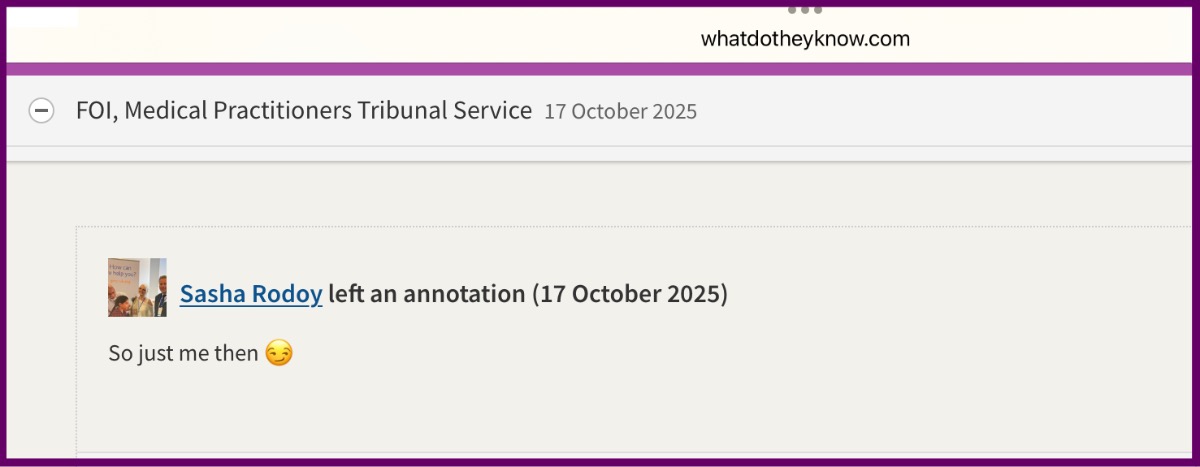
‘Having reviewed the determinations for the 98 preliminary hearings, I can confirm that the number is 1.’
This screen shot was my notation posted in response 👀
• 17 October 2025, my second FOI to the MPTS on the same topic:
FtP hearings for non GMC registrants, 2012 to 2018
www.whatdotheyknow.com/request/ftp_heari...r_2#incoming-3212577
‘Please provide the number of individuals who were not registered with the General Medical Council (GMC) but were the subject of a Fitness to Practise preliminary hearing before the Medical Practitioners Tribunal Service (MPTS) between its establishment in 2012 and the end of 2018.
Thank you
Sasha Rodoy
My Beautiful Eyes Foundation
Patient Advocate & Campaign Manager’
MPTS reply:
‘We have interpreted your request as relating to individuals who were not registered with the GMC but were the subject of a standalone preliminary hearing, separate from the substantive MPT that may, or may not, follow.’
‘On that basis, I can confirm that there were no such hearings convened to consider an individual not registered with the GMC.’
As my (multiple) preliminary hearings were in 2024, to be sure I have all the information, I sent another FOI today 😏
www.whatdotheyknow.com/request/ftp_heari...477#incoming-3216477
* Visit my TikTok series to follow this shocking story in detail: www.tiktok.com/@sasharodoy
Despite the official line, the GMC and MPTS do not operate as separate entities. The GMC respond to emailed MPTS enquiries, and even phone calls to the MPTS are answered by the GMC.
I have a lengthy trail of emails from their administrators and lawyers - dated before I became Public Enemy No 1 - repeatedly proving they don’t understand their own procedures, while the in-house legal teams act to protect the organisation above all else, regardless of the consequences for the public 😡
Based on the records and experiences I’ve collected, the public has virtually no chance of fair representation from the organisation mandated to protect us.*
Plenty more yet to come, but in the meantime, here’s the latest on my FOI requests to the MPTS.
• 21 August 2025:
FtP hearings for non GMC registrants
www.whatdotheyknow.com/request/ftp_heari...gistr#comment-123622
‘Since its inception in 2012, how many non GMC registrants have been the subject of a Fitness to Practise preliminary hearing before the Medical Practitioners Tribunal Service?
Thank you
Sasha Rodoy
My Beautiful Eyes Foundation
Patient Advocate & Campaign Manager’
Buried amongst their expected excuses for not providing this information, the MPTS replied:
‘We’ve identified 98 separate preliminary hearings since 2018 that we could examine to determine the issues that were considered. I can’t say how representative of a sample this would be. Alternatively we can investigate the possibility of looking at RoDs [Records of determinations] from a shorter period of time.’
My reply:
I don’t believe this is as difficult a task as you claim, and have been advised by a GMC insider that in all their years working with the organisation, they have never previously heard of a lay person appearing before an MPTS tribunal in the way I did.
Re: “We’ve identified 98 separate preliminary hearings since 2018 that we could examine to determine the issues that were considered.”
Please do so.’
MPTS:
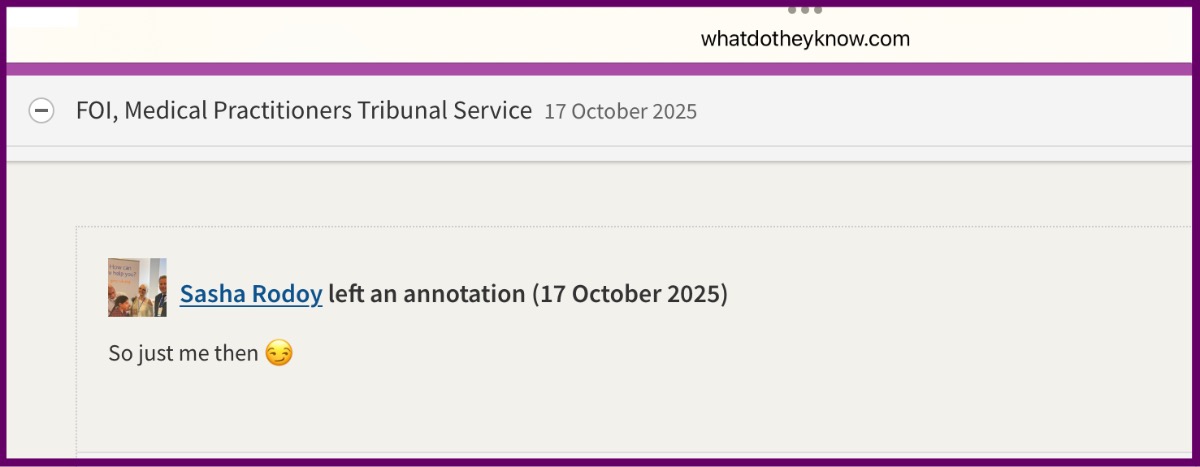
‘Having reviewed the determinations for the 98 preliminary hearings, I can confirm that the number is 1.’
This screen shot was my notation posted in response 👀
• 17 October 2025, my second FOI to the MPTS on the same topic:
FtP hearings for non GMC registrants, 2012 to 2018
www.whatdotheyknow.com/request/ftp_heari...r_2#incoming-3212577
‘Please provide the number of individuals who were not registered with the General Medical Council (GMC) but were the subject of a Fitness to Practise preliminary hearing before the Medical Practitioners Tribunal Service (MPTS) between its establishment in 2012 and the end of 2018.
Thank you
Sasha Rodoy
My Beautiful Eyes Foundation
Patient Advocate & Campaign Manager’
MPTS reply:
‘We have interpreted your request as relating to individuals who were not registered with the GMC but were the subject of a standalone preliminary hearing, separate from the substantive MPT that may, or may not, follow.’
‘On that basis, I can confirm that there were no such hearings convened to consider an individual not registered with the GMC.’
As my (multiple) preliminary hearings were in 2024, to be sure I have all the information, I sent another FOI today 😏
www.whatdotheyknow.com/request/ftp_heari...477#incoming-3216477
* Visit my TikTok series to follow this shocking story in detail: www.tiktok.com/@sasharodoy
Last Edit:15 Nov 2025 15:40
by Sasha
Please Log in or Create an account to join the conversation.
- Sasha
-
Offline
- Posts: 44
- Thanks: 1
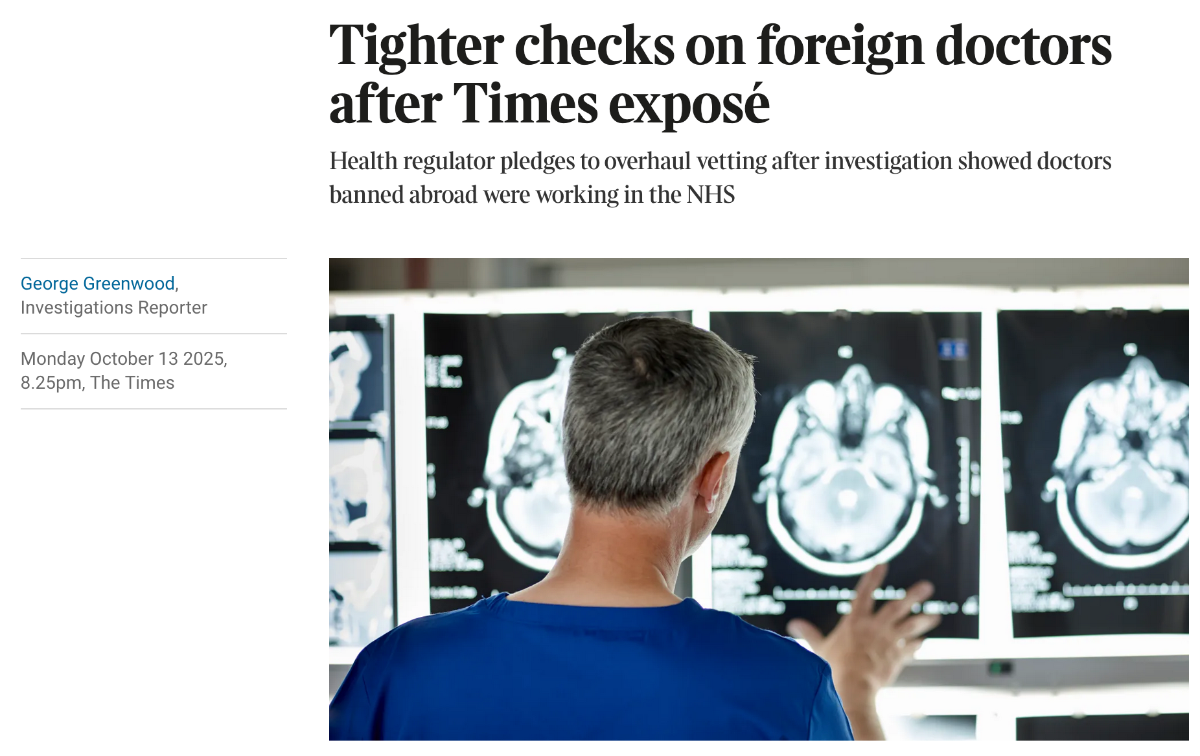
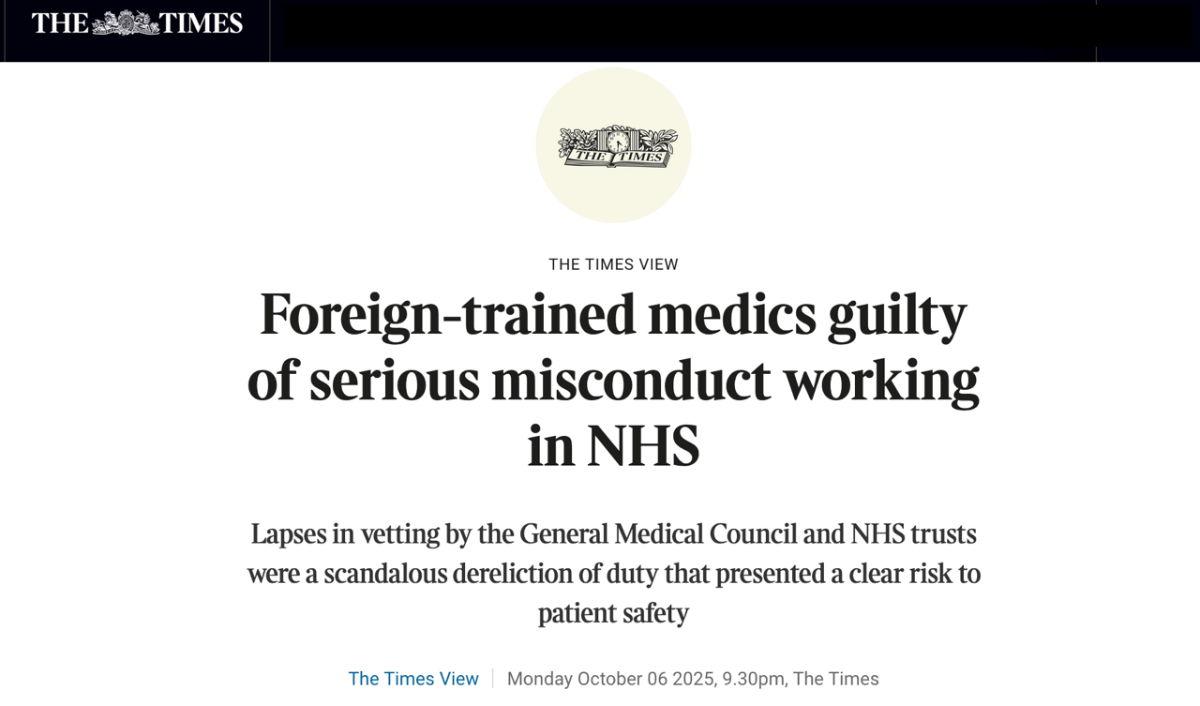
The General Medical Council (GMC) has pledged to overhaul its checks on foreign-trained doctors after The Times revealed how some who were banned overseas were cleared to treat patients.
The investigation revealed that 22 doctors had restrictions abroad with no record of this on their UK medical licences.
These included Sujan Thyagaraj, a psychiatrist employed by a Bradford NHS trust who lost his US medical licence for having sex with a patient, and Sattar Kadhem, a radiologist at NHS contractor Hexarad who lost his Swedish and Norwegian medical licences for misreading scans.
Thyagaraj has now been suspended by the trust, and Kadhem fired and referred to the GMC.
A spokeswoman for the GMC said the regulator would be “taking steps to tighten our registration checks and pushing for better international information sharing to stop doctors from hiding overseas sanctions”.
“This includes piloting tougher verification through specialist providers and pressing global regulators to share information more openly and consistently,” the spokeswoman added.
It is understood that other measures the regulator plans to pursue include lobbying the International Association of Medical Regulatory Authorities, which promotes co-ordination between licensing agencies, to ensure all members share information to avoid doctors slipping through loopholes.
The regulator is also understood to be lobbying for the European Network of Medical Regulatory Authorities to provide it with more comprehensive information on licence revocations from EU states.
The UK lost access to a common European database of medical licencing data after it left the EU, though not all EU countries fully participated in the scheme.
The revelation came from a cross-border investigation co-led by The Times, the Organised Crime and Corruption Reporting Project and the Norwegian newspaper VG, which for the first time collated doctor misconduct data from across the world.
Wes Streeting, the health secretary, ordered an urgent review of vetting procedures for foreign qualified doctors in response to The Times’s findings, describing them as “horrific” and “a serious failure in our medical regulatory systems that I will not tolerate”.
Paulette Hamilton, Labour MP for Birmingham Erdington who is the acting chair of the health select committee, has also raised concerns about further Times revelations that hundreds of doctors have been cleared to treat British patients without the GMC verifying their identity documents in person.
Analysis of a copy of the GMC licensing database showed that as of May this year, 505 doctors with full licences to practise had not had their IDs fully verified by staff at the health regulator.
The failure is a legacy of emergency licences issued to doctors during the Covid pandemic when it was temporarily made easier for doctors to register with the GMC, without having to present identity documents to officials in person.
While the GMC said that the number not vetted had fallen to 341 since May, it still left hundreds of doctors practising without the check having been completed, presenting a potential risk to patients.
Hamilton said: “This poses an ongoing risk to the safety of patients, and staff who work alongside them. This backlog needs to be tackled urgently to ensure trust in the NHS.“We would not tolerate this in any other public service, not least where lives are at stake.”
www.thetimes.com/article/838d9576-5093-43e8-b82e-34aeb3df656d
Last Edit:23 Oct 2025 16:23
by Sasha
Please Log in or Create an account to join the conversation.
- Sasha
-
Offline
- Posts: 44
- Thanks: 1
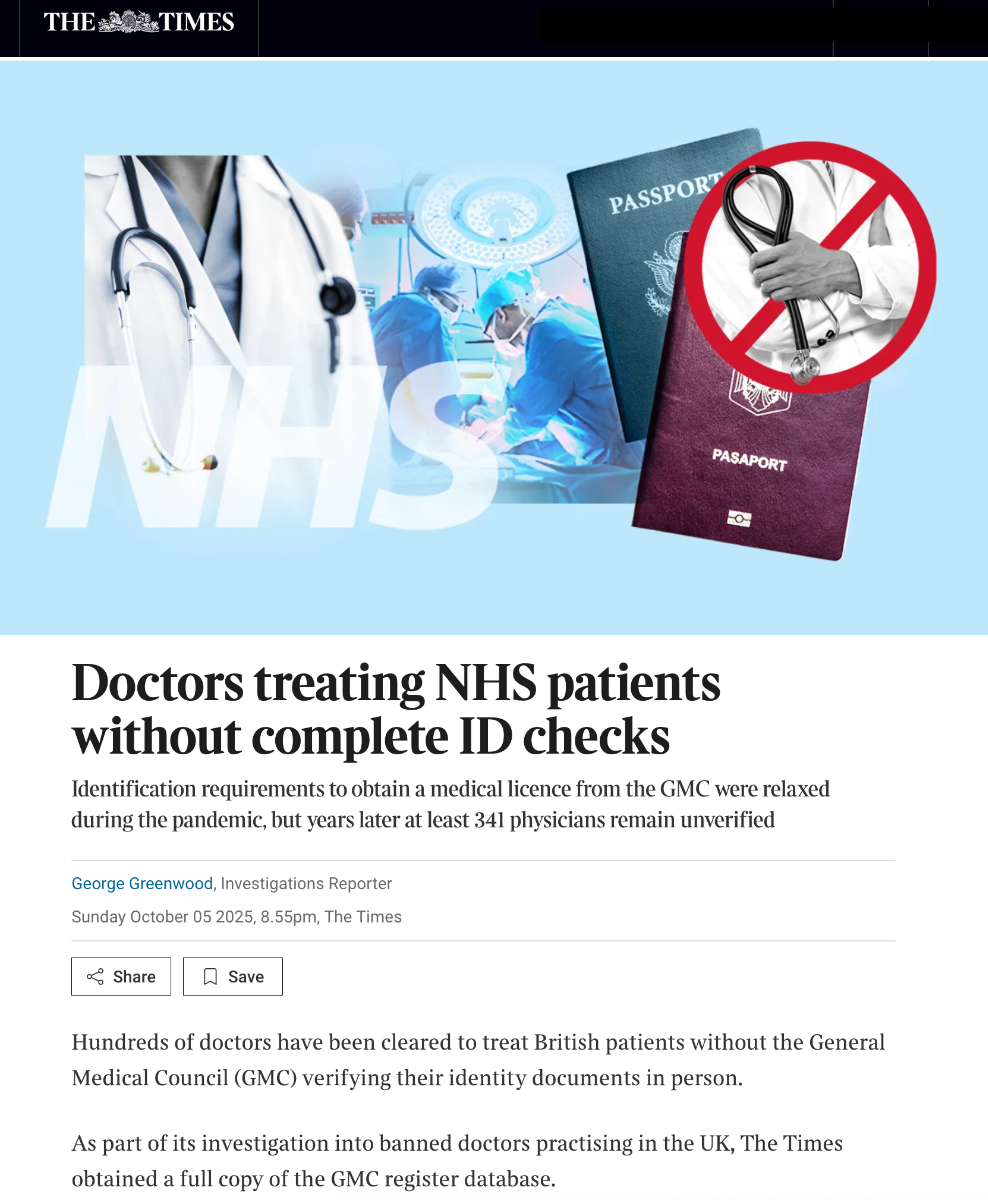
'Hundreds of doctors have been cleared to treat British patients without the General Medical Council (GMC) verifying their identity documents in person.As part of its investigation into banned doctors practising in the UK, The Times obtained a full copy of the GMC register database. Analysis of this database showed that as of May this year, 505 doctors with full licences to practise had not had their IDs fully verified by staff at the health regulator. The failure is a legacy of emergency licences issued to doctors during the Covid-19 pandemic, when it was temporarily made easier for doctors to register with the GMC.Those with a UK address, sufficient qualifications and no outstanding complaints were given temporary registration, without having to present identity documents to GMC officials in person.However, in the five years since the pandemic commenced, the GMC has not gone back to properly verify all of these doctors. While the GMC says the number not vetted has fallen to 341 since May, it still leaves hundreds of doctors practising without this check having been completed, presenting a potential risk to patients.The revelation about these further due diligence shortcomings comes after The Times revealed how some doctors who had serious misconduct findings against them abroad were cleared to treat NHS patients.These included Sujan Thyagaraj, a psychiatrist employed by a Bradford NHS trust who lost his US medical licence for having sex with a patient, and Sattar Kadhem, a radiologist who lost his Swedish and Norwegian medical licences for misreading scans. They were among 22 doctors identified who were subject to discipline or restrictions overseas but had no record of it showing on their GMC licences.Wes Streeting, the health secretary, ordered an urgent review of vetting procedures for foreign qualified doctors in response to The Times’s findings, describing them as “horrific” and “a serious failure in our medical regulatory systems that I will not tolerate”. Paul Whiteing, chief executive of Action Against Medical Accidents, said these missing ID checks were “a further cause for concern. At the heart of any effective registration system for doctors is a robust validation system.
“The evidence here would suggest that there are weaknesses in the validation process, which hopefully are historic. At worst this could lead to patient safety being compromised if doctors who are not fit to practise are allowed to do so.”Politicians across the spectrum are calling for action to close the loopholes used by these doctors to obtain medical licenses.Dr David Bull, the Reform UK chairman , said: “Clearly these people should never have been granted a licence to practice in the UK. The GMC is very rigorous with UK graduates so I have no idea why they have such lax vetting for foreign doctors.”Helen Morgan, the Liberal Democrat health and social care spokeswoman, said: “It beggars belief that doctors who’ve been struck off are slipping through the net. To rub salt in the wounds, this scandal has happened while excellent staff are laid off across the country and many doctors go unemployed.” A spokesman for the Professional Standards Authority, which oversees the UK’s health regulators, said it had “serious concerns” about the findings. It was “urgently reviewing” the actions the GMC was now taking relating to specific doctors and would be monitoring what action was needed to prevent the failures being repeated. A spokeswoman for the GMC said: “During the pandemic we had to pause in-person ID checks to comply with UK government guidance. We continued to verify all qualifications and conduct basic ID checks so that doctors were not prevented from joining the workforce to deal with the COVID emergency.”
“Doctors were advised they would need to verify their identities once restrictions were lifted, and a note was placed on their online record to reflect this. We also flagged this to employers and emphasised the importance of verifying IDs for this group of doctors as part of their usual recruitment processes.
“Since then, we have completed outstanding ID checks for thousands of these doctors. There are now 341 doctors outstanding and we have been contacting them and their employers to urge them to complete these checks as a matter of urgency. We have been clear that we can, and will, remove their licence to practise if they fail to comply.”'
www.thetimes.com/uk/healthcare/article/d...rification-z09ltnpk0
by Sasha
Please Log in or Create an account to join the conversation.
- Sasha
-
Offline
- Posts: 44
- Thanks: 1
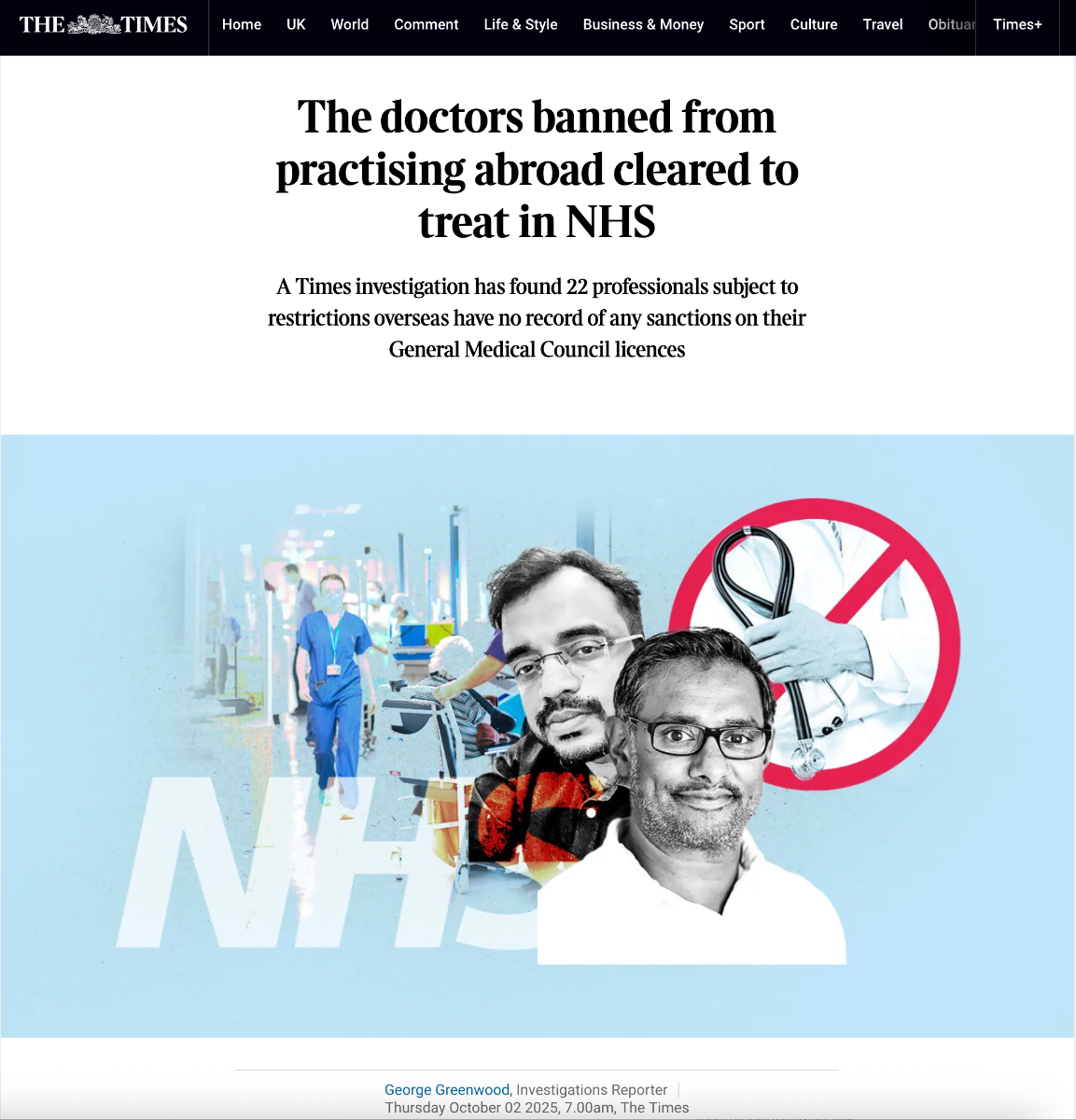
‘The health secretary has ordered an urgent review of vetting procedures for foreign qualified doctors after a Times investigation exposed how medics banned from practising overseas have been cleared to treat NHS patients.
Wes Streeting described the findings as “horrific” and “a serious failure in our medical regulatory systems that I will not tolerate”.
One doctor was fired when The Times approached their employer with its revelations, and another is under suspension.
Sujan Thyagaraj, a psychiatrist employed by a Bradford NHS trust, lost his US medical licence for having sex with a patient. Sattar Kadhem, a radiologist, lost his Swedish and Norwegian medical licences for misreading scans.
Despite this, both were granted the right to practise in the UK.
They were among 22 doctors identified by The Times who have been subject to discipline or restrictions overseas but with no record of it showing on their General Medical Council (GMC) licences.
In each case the GMC had either failed to spot the overseas findings — despite in some cases this information being public record — or it did not think the information should be available to patients.
Kadhem has since been dismissed by his employer and referred to the GMC. A Bradford District Care NHS Foundation Trust spokeswoman said it would be “factually inaccurate” and “libellous” to suggest it only took action after The Times approached it for comment, but repeatedly declined to say when it discovered Thyagaraj’s US misconduct.
Other doctors cleared to work in the UK included one found to have sexually harassed colleagues in Canada, another on the run from stalking charges and a third convicted in the US following an assault charge.
A lack of transparency about medical malpractice can be deadly. Dr Ajit Pothen wrongly discharged an NHS patient who later died after being permitted to work in a Nottingham hospital despite being suspended by a hospital in the Netherlands.
The findings come from a cross-border investigation co-led by The Times, the Organised Crime and Corruption Reporting Project (OCCRP) and the Norwegian newspaper VG, which for the first time collated doctor misconduct data from across the world.
Using a computer program, reporters compared the names and biographies of doctors who had been disciplined abroad with the names of doctors registered with the GMC, and where there was a match, verified this was the same person.
Doctors must normally prove that they meet GMC practise standards and provide evidence of their good standing in the countries where they previously worked to be admitted to the register, membership of which is necessary before working as a doctor in the UK. Some of the disciplinary notices were published by regulators, and could have been found by GMC vetting staff through a search engine. In other cases where these were not public, overseas medical regulators could have shared the information with the GMC if requested.
As of May, of NHS England’s 148,000 doctors, 57,000 were non-UK nationals.
A spokesman for the GMC said it was reviewing the findings to establish what regulatory action would be necessary.
From New Mexico misconduct to Bradford NHS trust
Sujan Thyagaraj specialises in treating vulnerable patients with conditions such as bipolar disorder and schizoaffective disorder.
He lost his medical licence in New Mexico in 2019 after the state medical board found he had had sex with a patient in his office.
He fled the country after US law enforcement attempted to collect his DNA.
He was later charged in absentia with sexual assault in relation to the case, but the criminal case was eventually halted.
The medical board concluded that he had had sex with the patient in the same appointment in which he prescribed her a powerful opioid.
As a result of the New Mexico investigation he also lost his licences in California and Texas.
He then attempted to obtain licences in other states, including in Montana, Hawaii and the US territory of Guam, but he was rejected based on his New Mexico suspension, which appeared on the first page of Google search results.
He succeeded, however, in his application to the GMC.
Thyagaraj obtained a UK medical licence this January before taking a role at Bradford District Care NHS Foundation Trust, the GMC register shows.
The trust declined to comment on when it became aware of the misconduct, citing the ongoing investigation.
Thyagaraj declined to comment, also citing the investigation.
Radiologist who missed key issues screened patients
One doctor was able to work for a radiology firm that treats NHS patients, despite having had his licences revoked in both Sweden and Norway.
The Swedish medical regulator revoked Sattar Kadhem’s licence in June 2023.According to a copy of his Swedish disciplinary report, Kadhem made repeated errors, and patient harm was only avoided because other colleagues spotted his mistakes.
The Swedish medical board found he was incompetent in his professional practise in a way that could impact patient safety in 2021, and placed him on a three-year probation.
He failed to appeal in the Swedish courts.
The mistakes at Swedish hospitals reviewing patient scans included missing a large blood clot, air trapped in a patient’s lungs, bone abnormalities, a spine fracture and misdiagnosing a bowel obstruction.
Kadhem did not meet the terms of the probation order, claiming illness meant he could not discuss his training requirements with regulatory officials. Because of his failure to engage, his licence was revoked.
Shortly afterwards, his Norwegian licence was revoked on the basis that he had lost his Swedish licence.
Kadhem declined to comment.
A spokesman for Hexarad, Kadhem’s employer, said that he had been immediately suspended after an approach by The Times, and had now been fired and referred to the GMC following an internal investigation.
Until 2022 Kadhem worked in the NHS, after his initial Swedish probation order.
A spokeswoman for the Royal Free London NHS Foundation Trust declined to comment on Kadhem’s case, but said all its radiologists were subject to regular internal audits to ensure the highest standards of patient care.
GP sexually harassed colleagues in Australia
Even where doctors with misconduct findings are spotted by the GMC, a lack of communication between health regulators can still leave patients exposed.
Dr Mark Anthony MacKenzie had his Australian medical licence revoked after the country’s regulator ruled that he had sexually harassed colleagues at a GP practice.
The Australian Health Practitioner Regulation Agency found that MacKenzie had made unwanted physical contact with staff at a practice, as well as touching himself inappropriately in front of colleagues. He was also found to have mishandled prescriptions.
MacKenzie left Perth, returning to the UK in 2021.
The GMC noticed his Australian ban and issued him with restrictions, preventing him from practising as a doctor unless the GMC approved. However, there is no record of any restrictions on his profile on the register of the Health and Care Professions Council (HCPC), which regulates specialist medical practitioners who are not practising as doctors.
MacKenzie is registered with the HCPC as a podiatrist and has been working at the Medipod podiatry clinic in Hinckley, Leicestershire.
The Times was able to photograph MacKenzie attending work at the clinic this year.
There is no record on Medipod’s website about him being struck off in Australia, and he did not disclose his work as a podiatrist during the open sections of his GMC hearing.
Medipod declined to comment, but MacKenzie’s profile has been removed from the company’s website.
The HCPC declined to comment on the specific case but a spokeswoman said that anyone who joined the register must declare if another organisation responsible for regulating a health profession had made a finding against them, and that if an individual was subsequently found to have not declared this information, it was possible that their application would be considered fraudulent.
MacKenzie said he had now notified the appropriate bodies but could not comment further until he had sought advice.
On Wednesday he received a nine-month suspension from the GMC.
‘He gave my mum a death sentence’
A failure to properly check a doctor’s practise history can have deadly consequences.
Ajit Pothen discharged Denise Barnes, who had attended Queen’s Medical Centre Campus in Nottingham with breathing difficulties, without properly reviewing her symptoms.
Barnes, 67, died shortly after.Pothen was struck off in the UK in 2021 for lying about his suspension in the Netherlands, and for wrongly discharging Barnes. He also lost his Dutch licence in 2022.
Despite this, Pothen has continued to work as a doctor in Germany. Barnes’s daughter, Nicola Bradley, said she was “very, very angry” to learn of his continued ability to practise.“He gave my mum her death sentence and he’s still living, and he is still working treating other people. What is it going to take before he actually loses his licence — is somebody else going to die under his care?”
The German-educated doctor was able to work shifts at Nottinghamshire Healthcare NHS Foundation Trust despite having been suspended by a hospital in the Netherlands. It is alleged in an official inspection report that Pothen made errors in treating four patients while working at UMC Utrecht.
These included one case in which he failed to conduct proper imaging before conducting a procedure, and one in which he accidentally caused “serious damage to a vital structure”.
While the hospital was found ultimately culpable for these cases, he was suspended and was under investigation when he moved to the UK to continue practising, without telling the GMC or the Nottingham NHS trust that he was not permitted to treat patients at the Dutch hospital.
He now co-runs Hansen and Pothen, an ear, nose and throat medical practice in Umkirch, Baden-Württemberg, where it is still possible to book appointments with him.
Lawyers for Pothen said the four cases of medical errors in the Netherlands did not result in any professional consequences for their client.
They said he downplayed the significance of the Dutch investigation to the NHS trust because of “a personally challenging phase of life”, but that his UK and Dutch revocations had “no effect on his German medical licence”. They said the relevant authorities in Germany had been informed, and there had been no complaints about his practise in Germany.
In relation to the death of Denise Barnes, the lawyers said Pothen “extends his sympathy”, but that “the deceased was not autopsied, and therefore there are no factual findings regarding the cause of death”.
The inquest into Barnes’s death shows a post-mortem examination was completed.
The Times sent a request for any “lessons learnt” reports completed by the trust following this case under freedom of information laws. The trust confirmed it had no record of any such report being completed.
The trust said that Pothen had not disclosed his full employment information at his appointment, and was referred to the GMC and later dismissed. It did not comment on what measures it had taken to check on his competency with his previous employer or why it had not completed any exercise to identify how to prevent a similar incident from happening again.
US arrest warrant was no bar to GMC licence
The Times analysis shows how the GMC repeatedly either failed to spot, or did not think it material to publicly disclose, serious concerns about a doctor’s personal conduct.
Dr Enyinnaya Ezema, a psychiatrist, received a four-month suspension in Nova Scotia, Canada, in July 2018 after a complaint against him for sexual harassment. The medical board found that he had made repeated sexual advances towards one colleague, including saying she “looked expensive”, and put his arms around another and ran his tongue along her bottom lip.
Ezema said that he had a “terrible” reference letter from the Nova Scotia medical board, which an overseas doctor must normally provide to the GMC before it will allow them to practise, but was able to obtain a licence to practise in the UK in 2019 by attending a “boundary course”. There is no record of this on his GMC page.
He claimed he told his employers about his practise history. He said the Nova Scotia findings were made by an “all-white panel”, questioning whether he had been the victim of institutional racism.
According to public records, in January he was listed as working as a locum psychiatrist at Omagh Hospital in Co Tyrone.
A Western Health and Social Care Trust spokeswoman confirmed that Ezema had worked at the trust as a psychiatrist, but said was no longer working there. She declined to comment further.
Another psychiatrist, Dr Edward Olugbemi, gave up his New Mexico licence in the US after a complaint was filed with the state medical board against him.
According to a separate civil action in the state, it is alleged that “within a few weeks after Olugbemi began working at [the hospital], Olugbemi commenced a pattern of sexually harassing employees at the facility”.
The case was eventually settled out of court. He is currently licensed as a locum doctor in the UK, and did not respond to a request for comment.
An aggravated assault conviction did not prevent Dr Adel Regaila from obtaining a UK medical licence. He was struck off by Florida’s medical board in 2006 for repeatedly sexually assaulting a patient. He admitted to lesser charges of assault at a criminal trial. He was granted a UK medical licence by the GMC in January. While appearing to be based in the Middle East, when The Times approached Regaila undercover asking for a remote consultation, posing as a UK patient, he responded later the same day offering his services.
When approached about whether he had told the GMC about losing his US licence, he did not respond, but days later relinquished his UK medical licence.
In another case, a US arrest warrant was no bar to a doctor from being licensed by the GMC.Dr Karim Sarhane had his medical licence suspended in Tennessee after being charged with stalking offences.
The plastic surgeon was arrested in 2022 after female residents in Nashville reported a man peeping into their windows.
Sarhane was charged with two counts of stalking and one of unlawful photography. The court said that he had not attended a hearing, and a warrant had been issued for his arrest.
He was granted a UK medical licence last year. He retained it despite his Tennessee licence being suspended in January. He now appears to be working in Abu Dhabi. He was approached for comment.‘
The current system is not working
’Streeting, the health secretary, said: “The public rightly expects that any doctor practising in this country meets the highest standards of professional conduct and these horrific allegations represent a serious failure in our medical regulatory systems that I will not tolerate.“Patient safety is my priority which is why I have taken immediate action, requesting urgent clarification from the General Medical Council about their processes for vetting international doctors seeking to work in the UK.
“I have also instructed NHSE to identify the status of these doctors and work with trusts to ensure patients and staff are kept safe as a matter of urgency. No doctor with serious misconduct findings should be able to slip through the cracks and practise in our NHS — no exceptions, no matter where they trained.
”Gary Walker, a partner at clinical negligence solicitors Enable Law, said: “The current system isn’t working and could put patients at risk.” He called for the GMC to conduct an urgent review of information-sharing arrangements.
He said: “Patients in the UK deserve and need to be able to trust that there are robust systems to ensure any doctor working in the UK is not subject to any restrictions or relevant criminal sanctions in another country.
”Paul Whiteing, chief executive of Action Against Medical Accidents, said it was “deeply worrying” that these doctors were able to continue to treat patients, saying regulators must have “fool-proof” systems for those who “try to move between countries in order to evade detection”.
A spokeswoman for the General Medical Council said: “We take our role protecting patients extremely seriously.
“Doctors wishing to gain registration should be under no illusion about their duty and responsibility to tell us about anything that might affect their ability to practise safely in the UK.
Our professional guidance makes this very clear.
“We will continue to review each case carefully and thoroughly and, where doctors are registered with us, decide what action we might need to take.”’
George Greenwood
www.thetimes.com/uk/healthcare/article/b...-streeting-m33rc9dtz
Additional reporting by Laurence Sleator, Alanah Hammond, George Willoughby and Lara Wildenberg
Last Edit:23 Oct 2025 15:58
by Sasha
Please Log in or Create an account to join the conversation.
- Sasha
-
Offline
- Posts: 44
- Thanks: 1
The GMC is not fit for purpose, raising grave concerns over corruption, transparency, and lack of support for victims of the refractive surgery industry.
Visit my TikTok and FundRazr pages to read shocking evidence, and learn more about these serious issues 👀
www.tiktok.com/@sasharodoy
fundrazr.com/sasharodoy
Visit my TikTok and FundRazr pages to read shocking evidence, and learn more about these serious issues 👀
www.tiktok.com/@sasharodoy
fundrazr.com/sasharodoy
Last Edit:15 Oct 2025 16:58
by Sasha
Please Log in or Create an account to join the conversation.
- Sasha
-
Offline
- Posts: 44
- Thanks: 1
Posted 10 March, re my Subject Access Request (SAR) to the General Medical Council (GMC): 'Over THREE MONTHS and still struggling, for what I have no doubt has involved quite a crowd, to decide how little of my personal data should be disclosed to me! And while I can't wait to see the black pages - that's if they take the trouble to redact instead of simply withholding...'
Seven days later I received a password to access the disclosure bundle - and guess what 😆
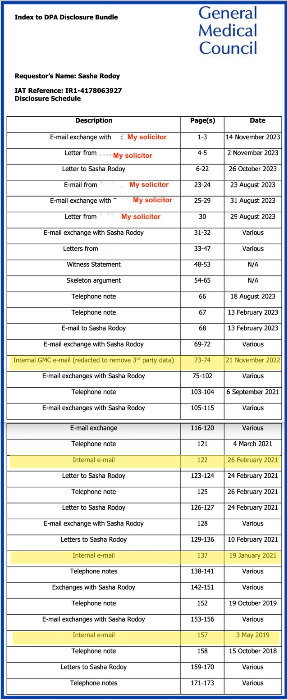
While there is a huge amount of my data missing, that I can prove quite easily, do they seriously expect me to believe that only FIVE internal emails exist mentioning my name?
In relation to Dr Prashant Jindal's FtP 2022 hearing alone, there has been extensive deliberation concerning me within the organization, and never mind my ears burning, they should have caught fire!*
And given that the GMC monitor my social media sites, surely they take screenshots, as do Optimax and Optical Express 👀
Meanwhile, still waiting for lo-ooong overdue SAR disclosure from the Medical Practioners Tribunal Service.
To be continued...
*Update soon!
#blindedonthehighstreet #stormsasha
While there is a huge amount of my data missing, that I can prove quite easily, do they seriously expect me to believe that only FIVE internal emails exist mentioning my name?
In relation to Dr Prashant Jindal's FtP 2022 hearing alone, there has been extensive deliberation concerning me within the organization, and never mind my ears burning, they should have caught fire!*
And given that the GMC monitor my social media sites, surely they take screenshots, as do Optimax and Optical Express 👀
Meanwhile, still waiting for lo-ooong overdue SAR disclosure from the Medical Practioners Tribunal Service.
To be continued...
*Update soon!
Seven days later I received a password to access the disclosure bundle - and guess what 😆
While there is a huge amount of my data missing, that I can prove quite easily, do they seriously expect me to believe that only FIVE internal emails exist mentioning my name?
In relation to Dr Prashant Jindal's FtP 2022 hearing alone, there has been extensive deliberation concerning me within the organization, and never mind my ears burning, they should have caught fire!*
And given that the GMC monitor my social media sites, surely they take screenshots, as do Optimax and Optical Express 👀
Meanwhile, still waiting for lo-ooong overdue SAR disclosure from the Medical Practioners Tribunal Service.
To be continued...
*Update soon!
#blindedonthehighstreet #stormsasha
While there is a huge amount of my data missing, that I can prove quite easily, do they seriously expect me to believe that only FIVE internal emails exist mentioning my name?
In relation to Dr Prashant Jindal's FtP 2022 hearing alone, there has been extensive deliberation concerning me within the organization, and never mind my ears burning, they should have caught fire!*
And given that the GMC monitor my social media sites, surely they take screenshots, as do Optimax and Optical Express 👀
Meanwhile, still waiting for lo-ooong overdue SAR disclosure from the Medical Practioners Tribunal Service.
To be continued...
*Update soon!
by Sasha
Please Log in or Create an account to join the conversation.
- Sasha
-
Offline
- Posts: 44
- Thanks: 1
3/3
29 February 2023, these emails coincidentally arrived within minutes of each other, four minutes to be exact; and as you can see, the MPTS more open about the fact that they obviously have every intention of heavily redacting my personal data - if even disclosing 👀
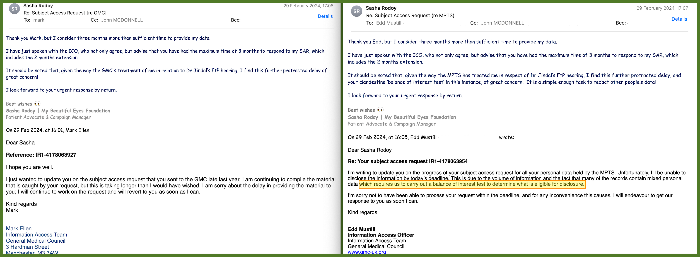
No matter what they'd have you believe, the GMC and MPTS are unarguably self regulating, answering to no one, the lack of transparency astounding, while interpreting the ‘balance of interest test’ to suit themselves: ico.org.uk/for-organisations/uk-gdpr-gui...interest-conditions/
See my FOI re public interest test and form your own conclusions:
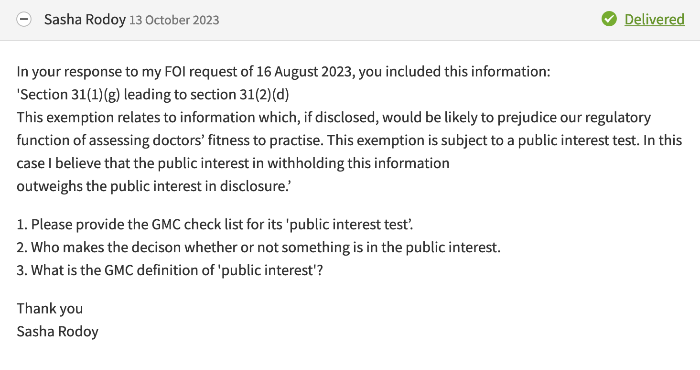
www.whatdotheyknow.com/request/public_interest_test_7
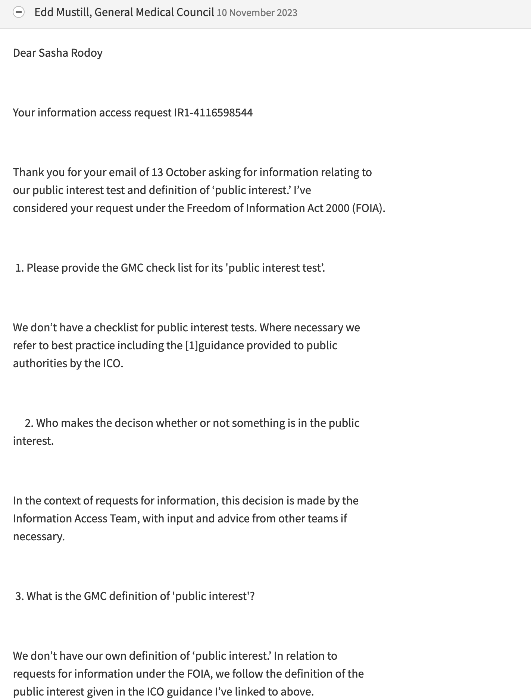
Over THREE MONTHS and still struggling, for what I have no doubt has involved quite a crowd, to decide how little of my personal data should be disclosed to me! And while I can't wait to see the black pages - that's if they take the trouble to redact instead of simply withholding, my complaints went to the Information Commisioner's Office (ICO) last week.
Meanwhile, I question whether complaints to the Professional Standards Authority are swept under the carpet (another FOI methinks!), but if you’ve had issues with the GMC or mpts, it's worth a try: concerns@professionalstandards.org.uk
29 February 2023, these emails coincidentally arrived within minutes of each other, four minutes to be exact; and as you can see, the MPTS more open about the fact that they obviously have every intention of heavily redacting my personal data - if even disclosing 👀
No matter what they'd have you believe, the GMC and MPTS are unarguably self regulating, answering to no one, the lack of transparency astounding, while interpreting the ‘balance of interest test’ to suit themselves: ico.org.uk/for-organisations/uk-gdpr-gui...interest-conditions/
See my FOI re public interest test and form your own conclusions:
www.whatdotheyknow.com/request/public_interest_test_7
Over THREE MONTHS and still struggling, for what I have no doubt has involved quite a crowd, to decide how little of my personal data should be disclosed to me! And while I can't wait to see the black pages - that's if they take the trouble to redact instead of simply withholding, my complaints went to the Information Commisioner's Office (ICO) last week.
Meanwhile, I question whether complaints to the Professional Standards Authority are swept under the carpet (another FOI methinks!), but if you’ve had issues with the GMC or mpts, it's worth a try: concerns@professionalstandards.org.uk
Last Edit:03 Apr 2024 15:54
by Sasha
Please Log in or Create an account to join the conversation.
- Sasha
-
Offline
- Posts: 44
- Thanks: 1
As do others I've spoken with (lawyers & doctors), I struggle to accept that the MPTS operates independently from the GMC 👀
'Requests to this body [mpts] are sent to the GMC Freedom of Information team.’
www.whatdotheyknow.com/body/mpts .
30 November 2023, I sent SARs to both GMC and MPTS, receiving this response on 14 December 2023, advising that they were allowed to extend the usual one month to three months, disclosure due by 29 February 2024.
And so I patiently waited…
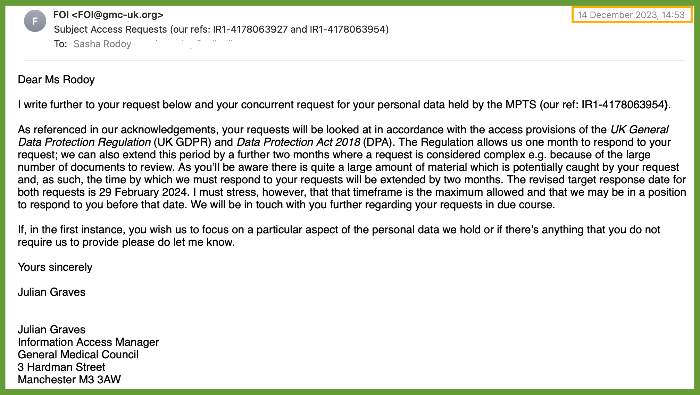
'Requests to this body [mpts] are sent to the GMC Freedom of Information team.’
www.whatdotheyknow.com/body/mpts .
30 November 2023, I sent SARs to both GMC and MPTS, receiving this response on 14 December 2023, advising that they were allowed to extend the usual one month to three months, disclosure due by 29 February 2024.
And so I patiently waited…
Last Edit:03 Apr 2024 15:53
by Sasha
Please Log in or Create an account to join the conversation.
- Sasha
-
Offline
- Posts: 44
- Thanks: 1
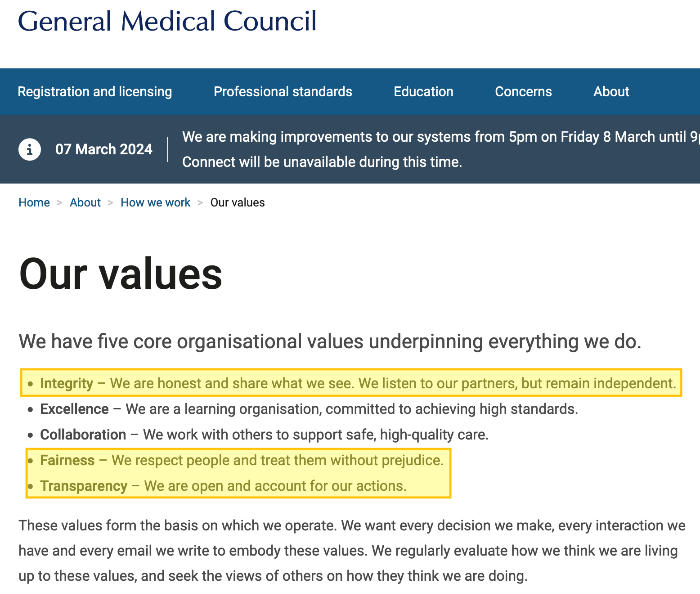
This 3 part thread is in the interests of transparency, a value advertised by the GMC, but unfortunately one that I have yet to witness 👀
www.gmc-uk.org/about/how-we-work/our-values
Last Edit:03 Apr 2024 15:51
by Sasha
Please Log in or Create an account to join the conversation.
- admin
-
 Offline
Topic Author
Offline
Topic Author
- Posts: 1164
- Thanks: 153
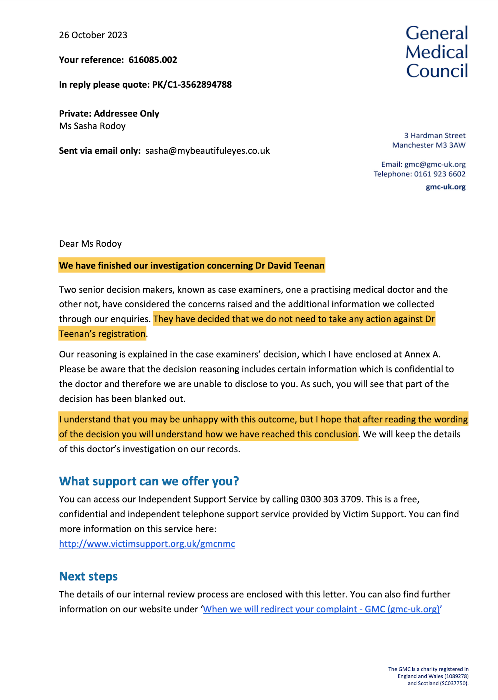
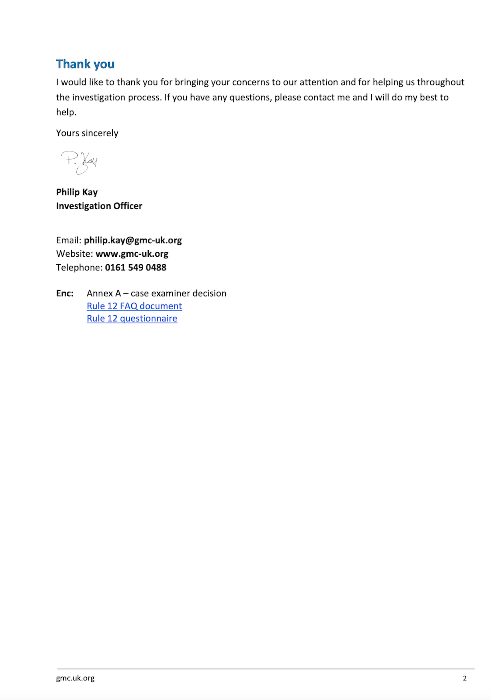
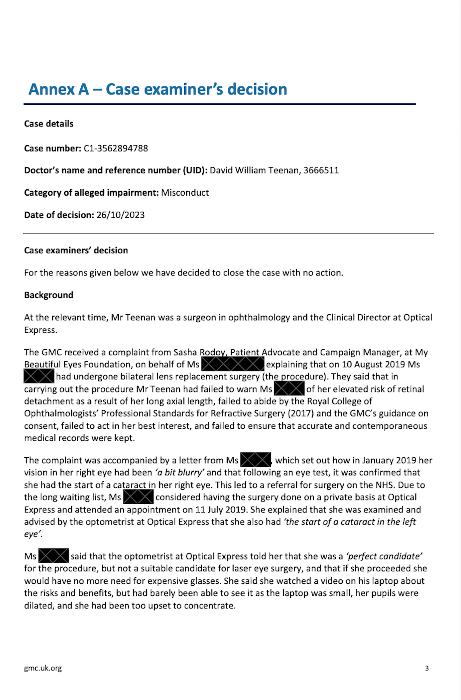
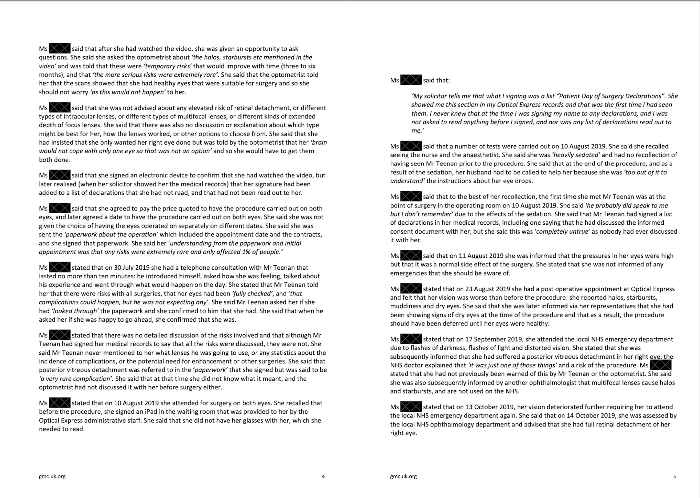
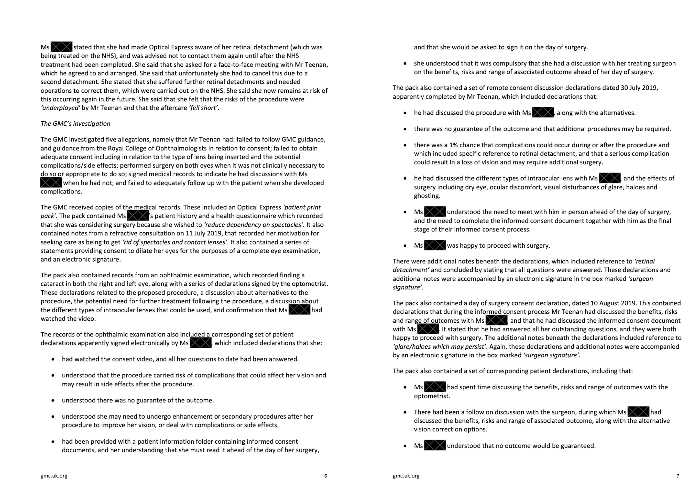
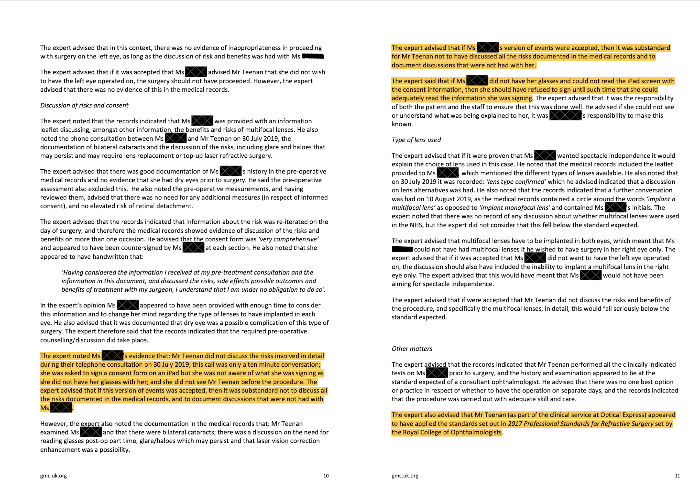
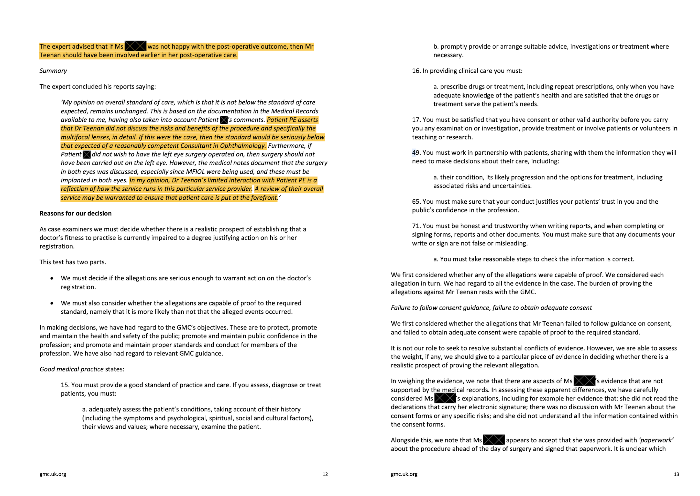
After reading the General Medical Council's latest 'closed without action' letter regarding Dr David Teenan’s fitness to practise, surely no one will disagree that the organisation (registered as a charity!) is #notfitforpurpose 👀
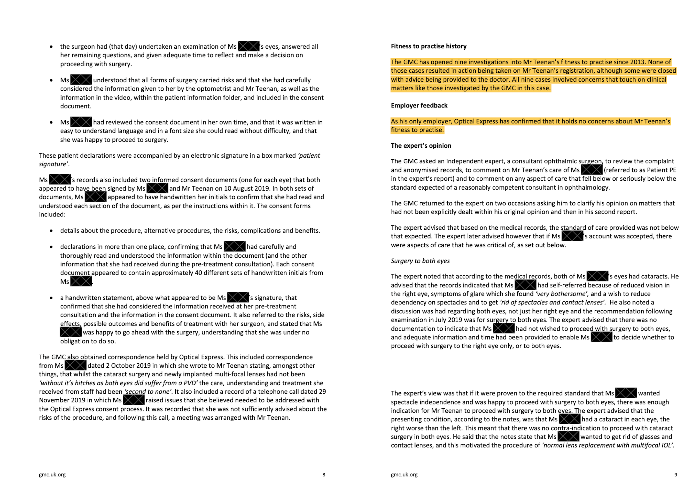
I've highlighted a few notable paragraphs in the scanned pages, and redacted Ms X's name at her request.
Page 9: 'The GMC has opened nine investigations into Mr Teenan’s fitness to practise since 2013. None of those cases resulted in action being taken on Mr Teenan’s registration, although some were closed with advice being provided to the doctor. All nine cases involved concerns that touch on clinical matters like those investigated by the GMC in this case.’
ONLY nine, all involving the same issues, so please tell how many patients eyes and lives must Dr David Teenan damage before these anonymous and incompetent case examiners decide that he should, at the very least, be referred to a FtP tribunal?
He has been (and is currently being) sued by dozens of patients he’s damaged, some actually blinded!*
Claims successfully settled, but always out of court, and I dream of the day OE will actually let another one go to trial, as to their regret they did with Stephanie Holloway’s £569,000 landmark case in 2104, because then the press and media can jump on it without fear of OE’s regular legal threats.
'As his only employer, Optical Express has confirmed that it holds no concerns about Mr Teenan’s fitness to practise.’
No sh*t Sherlock! Otherwise they’d be corroborating the ever increasing number of legal claims against the company and Teenan!
*Unfortunately the majority of people don’t bother to complain to the GMC, not least because they read stories like this and think what's the point!
But it is VERY important that complaints are made to the GMC - and to the General Optical Council, about all negligent surgeons and optoms, whether closed without action or not, because sooner or later this is going to backfire on all not fit for purpose UK regulators!
Please note that as patient advocate, I'm always willing to do this on the victim’s behalf, as I did with Ms X and others. Possibly the reason for the Medical Practitioners Tribunal Service & GMC's villification of me re Dr Prashant Jindal’s FtP hearing, because of course these cases cost a lot money to run - as seen in the answers to my FOI Qs 9-12: www.whatdotheyknow.com/request/info_re_d...p_h#incoming-2454822
PS: I'm not sure that Dr David Teenan's employment with OE entitles him to be addressed as 'Mr', but happy to be corrected if mistaken.
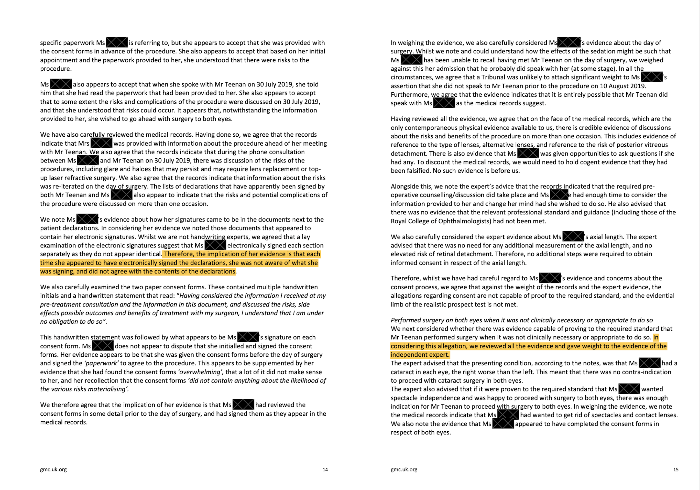
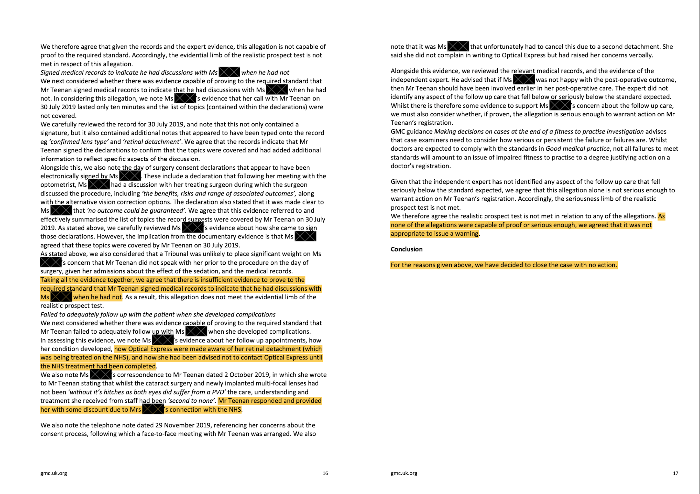
I've highlighted a few notable paragraphs in the scanned pages, and redacted Ms X's name at her request.
Page 9: 'The GMC has opened nine investigations into Mr Teenan’s fitness to practise since 2013. None of those cases resulted in action being taken on Mr Teenan’s registration, although some were closed with advice being provided to the doctor. All nine cases involved concerns that touch on clinical matters like those investigated by the GMC in this case.’
ONLY nine, all involving the same issues, so please tell how many patients eyes and lives must Dr David Teenan damage before these anonymous and incompetent case examiners decide that he should, at the very least, be referred to a FtP tribunal?
He has been (and is currently being) sued by dozens of patients he’s damaged, some actually blinded!*
Claims successfully settled, but always out of court, and I dream of the day OE will actually let another one go to trial, as to their regret they did with Stephanie Holloway’s £569,000 landmark case in 2104, because then the press and media can jump on it without fear of OE’s regular legal threats.
'As his only employer, Optical Express has confirmed that it holds no concerns about Mr Teenan’s fitness to practise.’
No sh*t Sherlock! Otherwise they’d be corroborating the ever increasing number of legal claims against the company and Teenan!
*Unfortunately the majority of people don’t bother to complain to the GMC, not least because they read stories like this and think what's the point!
But it is VERY important that complaints are made to the GMC - and to the General Optical Council, about all negligent surgeons and optoms, whether closed without action or not, because sooner or later this is going to backfire on all not fit for purpose UK regulators!
Please note that as patient advocate, I'm always willing to do this on the victim’s behalf, as I did with Ms X and others. Possibly the reason for the Medical Practitioners Tribunal Service & GMC's villification of me re Dr Prashant Jindal’s FtP hearing, because of course these cases cost a lot money to run - as seen in the answers to my FOI Qs 9-12: www.whatdotheyknow.com/request/info_re_d...p_h#incoming-2454822
PS: I'm not sure that Dr David Teenan's employment with OE entitles him to be addressed as 'Mr', but happy to be corrected if mistaken.
Last Edit:04 Nov 2023 16:46
by admin
Please Log in or Create an account to join the conversation.
Moderators: admin, Sasha